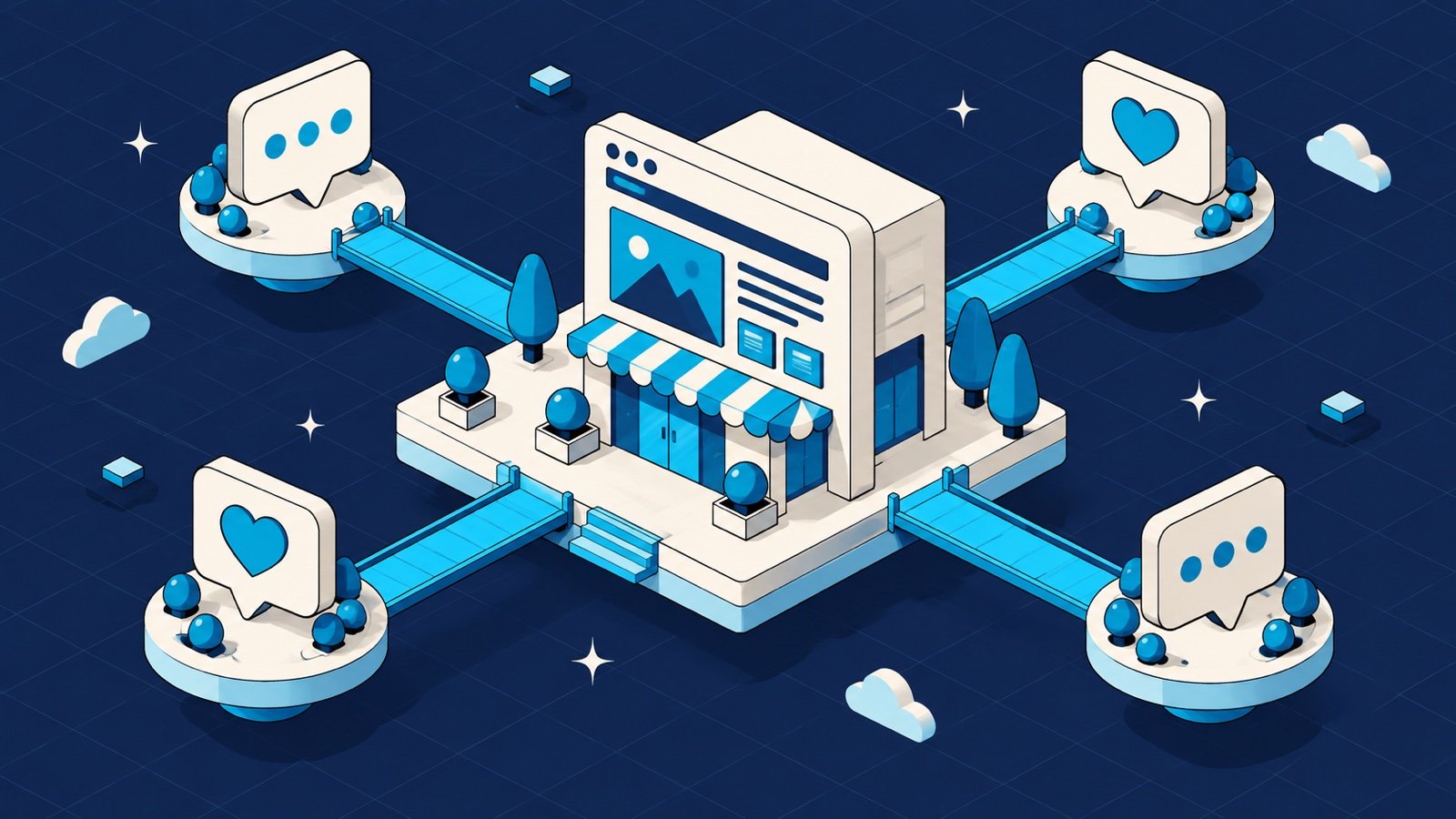
Yes, most serious businesses still need a website even if they have active social-media profiles. Social media is useful for discovery, conversation, and community. Your website is the stable place where customers can understand your services, verify your credibility, find you through search, and take action without depending on a platform’s feed or profile limitations. The strongest approach is to use both, with the website as the foundation.
Do I need a website if I have social media?
A social profile can help a new business start quickly, but it is not a complete replacement for a website. Customers use different channels at different stages. Someone may discover you through a post, look for reviews in search, compare your services on the website, and finally contact you through a form or phone call.
If the only detailed information about your business lives inside a social account, visitors must work around that platform’s navigation, login prompts, content order, and design. A website lets you organize the buying journey around the customer’s questions instead.
Website vs. social media: the practical difference
| Consideration | Business website | Social-media profile |
|---|---|---|
| Control | You control the pages, navigation, content hierarchy, and conversion paths | The platform controls the format, features, policies, and feed |
| Search visibility | Individual pages can target services, questions, and locations | Profiles and posts may appear in search, but offer limited page structure |
| Information depth | Detailed services, case studies, FAQs, pricing, and resources | Best for short updates, conversation, and recurring content |
| Credibility | Dedicated domain, professional email, proof, policies, and complete business information | Follower activity and public engagement can add social proof |
| Conversion | Custom forms, booking, calls, email, payments, and analytics | Platform-specific messages, links, and lead tools |
| Longevity | Evergreen pages remain organized and directly accessible | Older posts quickly move down the feed |
Six reasons your business should have its own website
1. Customers expect a complete source of truth
Your website can hold the current service details, service areas, hours, contact information, process, policies, and answers customers need. Social profiles should point back to that complete source rather than attempting to repeat every detail in every bio.
2. You control the experience
On your website, a visitor can move from problem to service, proof, FAQ, and contact form in a deliberate sequence. You can improve that sequence based on customer behavior. A social platform decides what a profile can display and which posts people see.
3. Search engines can understand individual services
A dedicated website page can completely answer one search intent—for example, emergency plumbing, residential roofing, or small-business website design. Clear page titles, headings, internal links, structured data, and supporting content help search and AI systems understand what the business offers.
4. A professional domain strengthens credibility
A dedicated domain and matching business email make the company easier to recognize and verify. The website can also present testimonials, licenses, certifications, team information, project examples, privacy practices, and clear terms in one consistent environment.
5. You can measure meaningful actions
Website analytics can show which services attract attention, which pages lead to inquiries, where visitors leave, and which campaigns create useful traffic. Social metrics such as views and likes are valuable, but they do not always represent qualified business interest.
6. Your best information remains findable
Important social posts are soon replaced by newer updates. Evergreen website pages remain in stable navigation and can continue attracting visitors through direct links and search. You can revise them when the business changes without rebuilding the entire content trail.
When can a business start with social media only?
A social-only presence can be reasonable for a brief validation stage: you are testing demand, accepting a small number of referrals, or preparing a launch. Even then, secure the domain you want and create a simple branded landing page as soon as practical. It can explain the offer, collect inquiries, and provide a stable link while the full site is being developed.
Social-only becomes risky when customers need detailed information, the service has a longer buying process, local search matters, you run paid campaigns, or the business depends on a platform for every inquiry.
The minimum website to build first
- A clear statement of what you do and who you help.
- Your core services and operating area.
- Real proof such as reviews, work examples, or credentials.
- A simple contact, booking, or quote path.
- A Privacy Policy and the business information customers need.
- Responsive design, fast loading, HTTPS, and basic search setup.
Our guide to the essential pages for a small-business website explains how to expand that foundation.
How to make your website and social media work together
- Use the same business name, contact information, visual identity, and core description everywhere.
- Link social profiles to the most relevant website page, not automatically to the homepage.
- Turn common social questions into permanent FAQs and useful articles.
- Share website case studies, guides, and service updates through social channels.
- Add accurate social profile links to the website once those profiles are active.
- Track inquiries and qualified actions rather than judging success only by follower counts.
For local companies, keep the website, Google Business Profile, directories, and social profiles consistent. Follow our 12-step local SEO checklist to connect the pieces.
Frequently asked questions
Can a Facebook or Instagram page rank in Google?
Social profiles and public posts can appear in search results. However, a business website provides far more control over service pages, structured information, internal links, calls to action, and the complete customer journey.
Is a one-page website better than no website?
Yes. A focused landing page on your own domain can establish the offer, provide essential proof and contact details, and give every social profile a stable destination. Expand it when the business needs more service and search coverage.
Should I stop using social media after launching a website?
No. Use social media for conversation, timely updates, community, and distribution. Use the website for durable information, search visibility, credibility, and conversion. The channels work best together.
Use social media as a channel—not your entire foundation
You do not need to choose between a website and social media. Build one clear, credible website that customers and search systems can rely on, then use social channels to bring the right people to it.
WebInCave designs, hosts, maintains, and supports small-business websites while helping align the surrounding search and social presence. Tell us what you need and we will recommend a practical starting point.